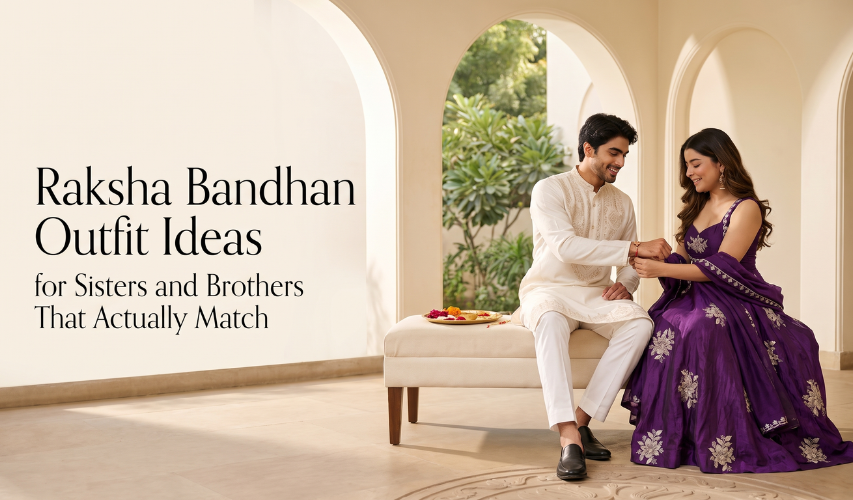
A good saree for rakshabandhan paired with a matching kurta for the brother is the easiest way to create a coordinated Raksha Bandhan look without shopping for separate color palettes. This guide covers saree picks, kurti options, salwar kameez styles, men’s kurta pajama pairings, and color combinations that photograph well and suit both Indian and Indian-diaspora celebrations in the USA, UK, and Canada.
What Should Sisters and Brothers Wear for Raksha Bandhan
The simplest coordination formula is one shared color family across two different garments.
- Sister wears a saree for Rakshabandhan or a kurti for Rakshabandhan
- Brother wears a kurta pajama in a matching or complementary shade
- Both outfits use one dominant color plus one neutral (gold, cream, or white)
This approach works because it does not require identical outfits, which most siblings find too matchy for a family function. A shared color story reads as coordinated in photos while letting each person wear a silhouette that suits their comfort.
Saree for Rakshabandhan: What to Pick
A saree for Raksha Bandhan should balance festive color with practical wearability, since most Raksha Bandhan mornings involve travel to a family home, a tikka ceremony, and a shared meal right after.
- Silk-blend sarees in navy blue saree or sky blue shades work for both daytime and evening functions
- A Raksha Bandhan special saree in Banarasi or Chanderi fabric adds festive weight without heavy embroidery
- Lighter cotton-silk blends suit warmer regions or outdoor family gatherings
- Pastel and jewel-tone sarees photograph better than very dark colors for daytime rituals
A rakhi saree in a single solid color with a contrast border is one of the fastest ways to build a coordinated look with a brother’s kurta, since solid colors are easier to match than heavily printed fabric.
Kurti Options for Raksha Bandhan
Sarees are traditional, but many sisters prefer a kurti for rakshabandhan for comfort during a full day of family visits.
- Straight-cut kurtis in cotton or rayon work well for daytime functions and travel
- A-line kurtis with light gota or thread work suit a more festive evening celebration
- Pairing a kurti with palazzo pants gives more ease of movement than a saree for younger sisters
- Kurtis for Raksha Bandhan in mirror-work or block-print styles suit regional and Rajasthani-themed family functions
For sisters coordinating with brothers wearing a pathani suit or achkan, a kurti in a matching jewel tone keeps the pairing visually connected without both outfits looking identical.
Salwar Kameez Styles for Raksha Bandhan
A salwar kameez is another practical choice for sisters who want a full outfit rather than pairing separate pieces, and it works across a range of family function styles.
- Anarkali suits give a flared, festive shape that suits an evening rakhi dinner
- Sharara salwar kameez sets add movement and work well for families combining Raksha Bandhan with a bigger celebration
- Straight cut salwar suits are the easiest to match to a brother’s kurta pajama since the silhouette stays simple
- Designer salwar kameez sets suit sisters who want a more detailed look without switching to a lehenga
- Punjabi suits are a common pick for families with North Indian roots and pair naturally with a dhoti kurta or achkan
- Churidar suits fit close to the leg and travel well, which helps for sisters visiting more than one family home on the same day
Any of these can follow the same color-matching rule used for sarees and kurtis: pick the brother’s kurta pajama shade first, then choose the salwar kameez style in the same or a complementary color.
What Brothers Should Wear to Match
Men’s Raksha Bandhan outfits tend to follow three main categories, and each pairs differently with a sister’s saree or kurti.
- Kurta pajama: the most common choice, easy to match to any saree or kurti color
- Dhoti kurta: suits families following a more traditional or regional dress code
- Pathani suit: a straight-cut option that works well for younger brothers who prefer a modern silhouette
A brother in a plain kurta pajama and a sister in a raksha bandhan special saree with the same base color creates a coordinated look without either outfit needing an exact print match.
Color Combinations That Work Well Together
Matching does not mean identical. The strongest sibling pairings use one shared color with two different garment types.
- Navy blue saree with a white or cream kurta pajama
- Sky blue saree with a beige or off-white dhoti kurta
- Wine-coloured saree with a cream achkan
- Mustard or gold saree with a white Pathani suit
Regional saree styles also work for families who prefer a specific cultural identity for the day, such as a Gujarati saree (also searched as Gujarati saree) or a Rajwadi saree for Gujarati households, paired with a matching bandhani-print kurta.
Building a Full Raksha Bandhan Collection at Home
Families who celebrate Raksha Bandhan alongside other festivals in the same season often shop once for a full raksha bandhan collection rather than buying separate outfits for each event. Checking the raksha bandhan collection total before ordering, meaning the full count of saree, kurti, and kurta pieces needed for every sibling in the family, avoids a last-minute second order closer to the festival date.
- One saree in a versatile color that works for the Rakhi ceremony and a follow-up family dinner
- One or two kurtis for daytime errands, gifting visits, and pre-festival shopping trips
- Matching or complementary kurta pajama sets for brothers, sized ahead of the festival date
- Simple jewelry, such as a pendant set, that pairs with more than one outfit
According to the Ministry of Culture, Government of India, Raksha Bandhan falls on the full moon day of the Hindu month of Shravana, and the exact date shifts each year based on the lunar calendar. Checking the confirmed date early gives enough time to order, alter, and try on outfits before the actual ceremony.
Shopping Tips for Sisters Abroad
For families in the USA, UK, and Canada celebrating Raksha Bandhan away from India, timing the order matters as much as the outfit choice.
- Order sarees and kurta sets at least two to three weeks before the festival date to account for international shipping
- Choose wrinkle-resistant fabrics such as silk blends or cotton-silk for easier travel and storage
- Keep a spare rakhi thread and tikka kit on hand in case courier timelines shift
- Confirm blouse stitching or alteration options before ordering a saree, since most sisters abroad do not have quick access to a local tailor
A matching saree and kurta set bought together, rather than separately, reduces the risk of color mismatch once the fabric arrives and is seen in natural light rather than on a screen.
Final Word on Coordinating Outfits
The easiest way to get Raksha Bandhan outfits right is to pick one color family first, then choose the saree, kurti, or kurta pajama within that range. A saree for Rakshabandhan in a solid or lightly printed fabric gives the most flexibility for matching with a brother’s outfit, whether he wears a kurta pajama, dhoti kurta, or Pathani suit. Ordering early, especially for families abroad, leaves enough time to check fit and fabric before the actual celebration.