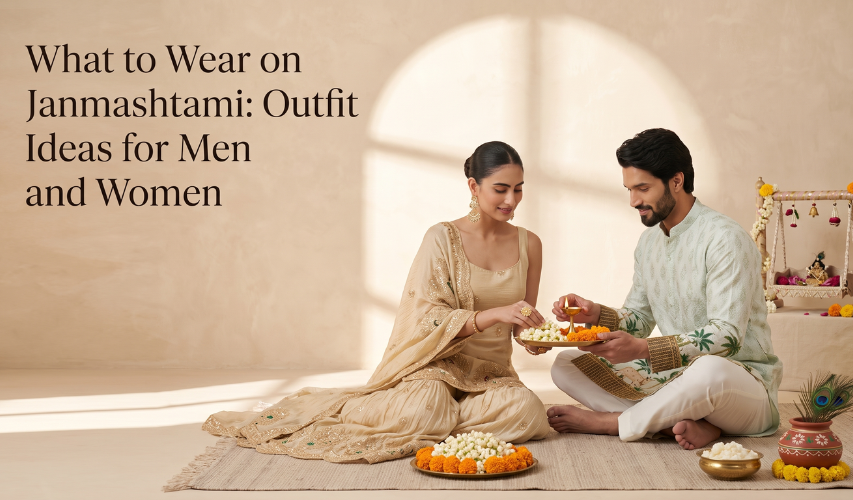
If you’re short on time, here’s the direct answer: our go-to Janmashtami outfit ideas are a yellow or peacock-blue dhoti kurta for men and a saree or lehenga in yellow and blue for women, both in breathable cotton or cotton-silk. That’s what to wear on Janmashtami if you want something that looks right for temple visits and still holds up through a dahi handi crowd.
We ship festive ethnic wear across India every Janmashtami season, and the fabric question comes up more than the color question. Bhadrapada falls squarely in the monsoon, so a heavy silk that looks good in a product photo can turn uncomfortable within an hour of humidity and crowd heat. This guide sticks to what actually works on the day itself.
What Colours Are Traditionally Worn on Janmashtami and Why?
Yellow and blue are the two colours most associated with Janmashtami. Yellow is linked to Krishna’s traditional “pitambar” dhoti, and blue (or peacock tones) echoes the way Krishna is depicted in art and temple idols, along with the peacock feather he’s shown wearing. As Britannica explains, the festival marks the birth of Krishna, an avatar of the god Vishnu, observed on the eighth day of the dark fortnight of the month of Bhadrapada and the festival’s visual traditions, from temple decoration to idol dressing, draw on this same iconography. We’re describing common practice here, not claiming religious authority; family and regional traditions vary, and some households also lean into peacock green or white for daytime puja.
Practically, yellow and blue also photograph well together for the family pictures everyone ends up taking at Dahi Handi, which is part of why the pairing has stayed popular in festive wear.
What Should Men Wear on Janmashtami?
A Janmashtami kurta for men paired with a dhoti is the most common choice, and for good reason it’s traditional, it’s comfortable to sit in for evening puja, and it moves easily if you’re joining a dahi handi human pyramid later. A dhoti kurta for men in cotton or cotton-silk breathes better than pure silk once the evening gets humid, and it doesn’t cling the way heavier fabrics do.
If a dhoti isn’t your thing, a pathani suit is a solid middle ground straight-cut, less fabric bunching at the waist, and easier to move in if you’re standing for hours. For a more festival-specific look, a Krishna costume for men with a mor pankh (peacock feather) crown and a flute accessory works well for kids’ events and community stage programs, though for temple visits most adults keep it simpler, just the kurta and a peacock feather pin or brooch.
Colour-wise, a yellow dhoti kurta is the closest to traditional pitambar styling. If you’re the one climbing in the dahi handi pyramid, skip anything with heavy embroidery on the shoulders it catches and pulls. A plain or lightly-worked yellow dhoti for Janmashtami holds up better through the actual event than a heavily embellished one.
What Should Women Wear on Janmashtami?
This is where saree vs. lehenga vs. kurta actually matters, and it depends on what your evening looks like. If you’re mostly at a puja and staying seated or standing in one spot, a Janmashtami saree in yellow or blue silk-cotton gives you the traditional draped look without restricting movement much. If you’re heading to a dahi handi event where you’ll be standing, dancing, or navigating a crowd for a few hours, a lehenga or a well-fitted kurta set is genuinely more practical; a saree pallu can slip or need re-pinning when you’re moving a lot.
Janmashtami dress ideas for women often lean into Radha-Krishna colour pairing think a yellow-toned outfit worn alongside a partner in blue, or the reverse. This yellow-and-blue combination is the most requested pairing in our festive collection every year around this time. If you want a full janmashtami lehenga look, go for a lighter lehenga fabric rather than heavy velvet; it drapes better in humidity and doesn’t add extra weight while you’re standing through an event.
For a lower-maintenance option that still reads festive, a simple kurta set in yellow or blue works, especially for daytime celebrations or if you’re also managing kids.
What to Dress Kids in for Janmashtami?
Kids’ Janmashtami outfits tend to fall into two camps: the Krishna/Radha costume look for photos and stage programs, and simpler everyday festive wear for temple visits. For girls, a small kids ethnic wear lehenga or ghagra-choli in yellow or peacock blue works for both. For boys, a kids’ ethnic wear dhoti-kurta set with a small mor pankh crown covers the classic baby Krishna look that most schools and communities ask for.
Fit matters more than styling for younger kids; go a size looser than usual so they can sit, crawl, or run around without the outfit restricting them, and skip stiff fabrics that can irritate skin in monsoon humidity.
How Do I Style a Radha-Krishna Look as a Couple or Family?
The easiest way to do a coordinated family look without it feeling costume-y is to pick one shared colour anchor, usually yellow or blue, and let each person’s outfit use it differently. The man might wear a yellow dhoti kurta while the woman wears a blue-and-yellow saree or lehenga, and kids follow the same two-colour palette in simpler cuts. Adding peacock feather jewellery, a hairpin, brooch, or small pendant ties the family looks together without needing everyone in a full costume.
Keep accessories light if you’re going to be outdoors for Dahi Handi. Heavy jewellery and tall crowns are fine for photos at home, but they get uncomfortable fast in a moving crowd.
Shop the Look
- Men: dhoti kurta for men, pathani suit, yellow dhoti kurta
- Women: Janmashtami sarees, Janmashtami lehenga
- Kids: girls’ ethnic wear, boys’ ethnic wear
- Accessories: peacock feather jewellery
FAQ
1. What colour to wear on Janmashtami?
Yellow and blue are the most traditional choices, but peacock green and white also show up in some households and regions. There’s no single mandatory colour.
2. What are some Janmashtami outfit colour ideas beyond yellow and blue?
Peacock green, mustard yellow with a blue dupatta, and white with gold accents are common alternatives if you want to stay traditional without repeating the standard yellow-blue pairing.
3. What should I get for a Janmashtami dress for kids?
A loose-fitting dhoti kurta for boys or a simple lehenga/ghagra-choli for girls, in breathable cotton, works better than a stiff costume for a full evening of temple visits or dahi handi.
4. What are some simple Janmashtami outfit ideas if I don’t want a full costume?
A plain yellow or blue kurta set for women, and a kurta with a dhoti or pyjama for men, both without heavy embroidery. Add one accessory, a peacock feather pin or a tulsi mala, instead of a full head-to-toe look.
5. Is silk or cotton better for Janmashtami given the weather? Cotton or cotton-silk blends are the more practical pick since Janmashtami falls during the monsoon. Pure silk can feel heavy and clingy in humidity, especially if you’re standing for a dahi handi event.
However you put it together, the goal is to look festive without fighting the outfit all evening. The best Janmashtami outfit ideas are usually the simplest ones that fit the weather and the actual plans for the day, whether that’s a quiet puja at home or hours out at a dahi handi event.